Holmium Laser Enucleation of the Prostate (HoLEP)

Medical Review & Verification: Dr. Niti Navanimitkul, M.D.
Board-Certified Urological Surgeon | Advanced Prostate Diagnostics Specialist | M-Trust Urology Clinic • UroLift Treatment for BPH (100+ cases, 99.99% success rate) • Water Vapor Therapy (Rezūm) - Center of Excellence • Prostate Cancer Screening & Treatment
Last Reviewed: July 2026The gold standard surgical treatment for all prostate sizes. Highly effective, minimal bleeding, and the lowest long-term retreatment rates.
What is HoLEP?
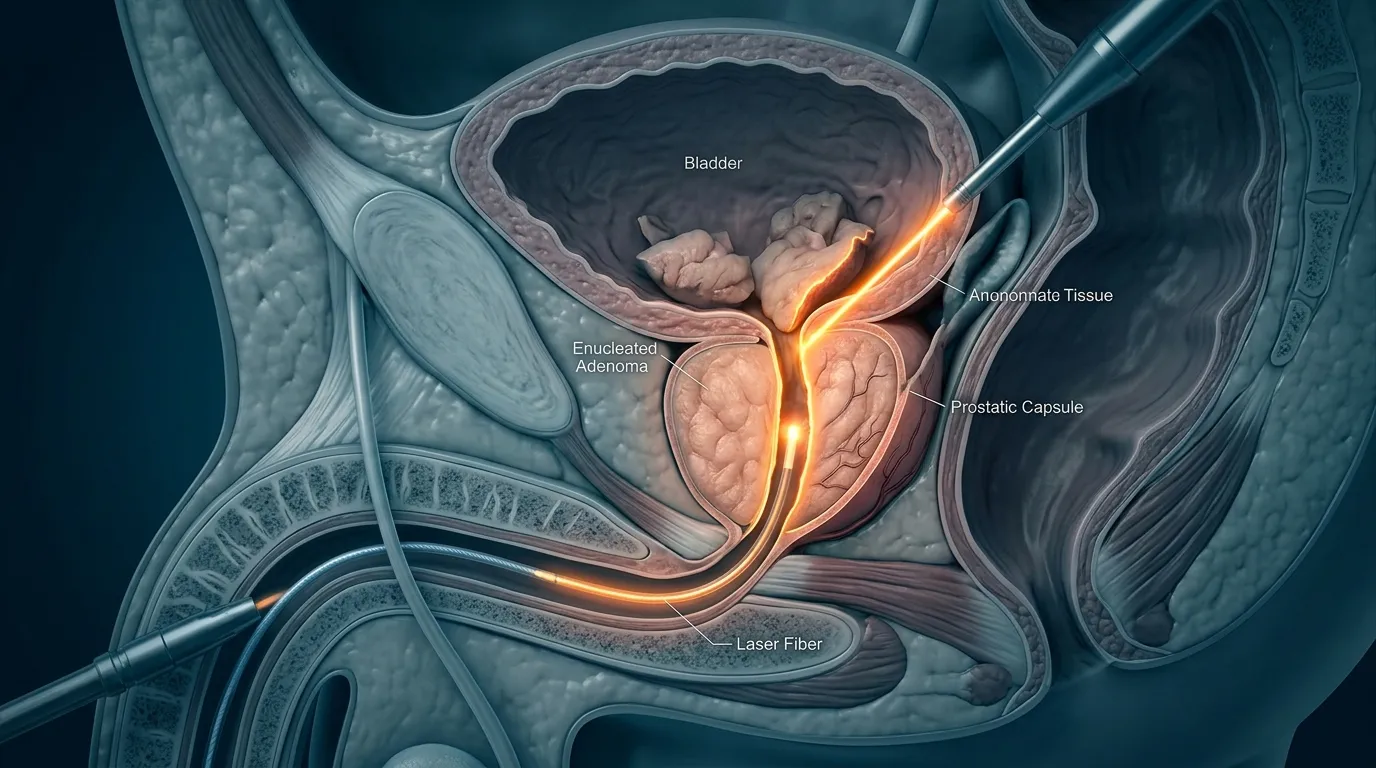
HoLEP (Holmium Laser Enucleation of the Prostate) is an advanced, minimally invasive surgical procedure that uses a holmium laser to treat Benign Prostatic Hyperplasia (BPH). It is strongly endorsed by both the American Urological Association (AUA) and the European Association of Urology (EAU) as a highly effective, size-independent treatment.
Unlike traditional scraping methods (TURP), HoLEP involves anatomically dissecting or 'enucleating' the entire obstructive portion of the prostate gland right at the surgical capsule. This allows urologists to treat even massively enlarged prostates (well over 100cc) entirely through the urethra, offering an outcome similar to an open prostatectomy but without any external incisions.
Deep Dive: Mechanism of Action
The HoLEP procedure is technically demanding but offers unparalleled precision. It involves the following key steps:
1. Laser Enucleation
A high-powered holmium laser is used to meticulously separate the obstructive prostate adenoma from the surgical capsule. The laser's excellent hemostatic properties simultaneously seal blood vessels, making the procedure nearly bloodless.
2. Displacing the Tissue
The enucleated lobes of the prostate are pushed backward into the bladder, completely opening the prostatic urethra.
3. Morcellation
A specialized mechanical instrument called a morcellator is inserted to rapidly suction and cut the floating adenoma tissue into small pieces, removing them from the bladder.
4. Pathological Analysis
The extracted prostate tissue is collected and sent to a pathology lab to rule out incidental prostate cancer—an advantage over ablative techniques like Rezūm where tissue is destroyed in place.
Pros and Cons of HoLEP Surgery
⊕ ข้อดี (Pros)
- ✓Completely size-independent; can effectively treat prostates larger than 100cc to over 200cc.
- ✓The most durable BPH treatment available, with a 10-year retreatment rate of less than 1%.
- ✓Excellent hemostasis (blood control) makes it a safer option for patients on anticoagulants.
- ✓Shorter catheterization time (typically 1-2 days) and faster hospital discharge compared to open surgery or TURP.
- ✓Provides a complete tissue sample for prostate cancer screening.
⊖ ข้อจำกัด (Cons)
- ✗Requires general or spinal anesthesia.
- ✗Requires an overnight hospital stay (usually 1-2 nights).
- ✗Almost universally results in retrograde ejaculation (semen enters the bladder during climax), though erectile function is generally preserved.
- ✗Potential for temporary stress urinary incontinence or dysuria in the initial weeks/months post-surgery.
- ✗Technically challenging procedure with a steep learning curve; requires a highly specialized surgeon.
Who is a Candidate for HoLEP?
According to urological guidelines, HoLEP is highly recommended for:
- ▹Men with moderately to severely enlarged prostates (typically >80cc, with no upper size limit).
- ▹Patients experiencing severe lower urinary tract symptoms (LUTS) or those in complete urinary retention.
- ▹Men who have concurrent bladder stones, as the holmium laser can simultaneously break down stones.
- ▹Patients seeking the most durable, permanent solution and who are not concerned about retrograde ejaculation.
- ▹High-risk patients taking blood-thinning medications where traditional surgery poses a high bleeding risk.
Comparison: HoLEP vs. Traditional TURP vs. BPH Medications
An academic comparison of efficacy, safety profiles, and impact on long-term quality of life.
Clinical Outcomes & Durability
Extensive clinical data spanning over decades demonstrates HoLEP's superiority in long-term outcomes:
Increase in Qmax
Patients experience a massive improvement in peak urinary flow rates compared to baseline.
10-Year Retreatment
Because the entire adenoma is removed, regrowth causing obstruction is exceedingly rare.
IPSS Reduction
Provides the highest sustained reduction in symptom severity scores among BPH interventions.
Recovery & Post-Operative Care
While HoLEP removes a significant amount of tissue, the laser technology facilitates a smooth recovery:
- •Hospital Stay: Most patients stay 1 to 2 nights for bladder irrigation and monitoring.
- •Catheter Removal: The urinary catheter is usually removed within 24 to 48 hours after surgery.
- •Temporary Incontinence: A small percentage of patients experience temporary stress incontinence or urgency, which typically resolves within a few weeks to months with Kegel exercises.
- •Activity Restrictions: Strenuous activities, heavy lifting, and straining must be avoided for 4-6 weeks to prevent secondary bleeding.
Clinical References
- American Urological Association (AUA) Guidelines on the Management of Benign Prostatic Hyperplasia (BPH).
- European Association of Urology (EAU) Guidelines on Management of Non-Neurogenic Male LUTS.
- Gilling PJ, et al. 'Long-term results of a randomized trial comparing holmium laser enucleation of the prostate and transurethral resection of the prostate.' Journal of Urology, 2012.